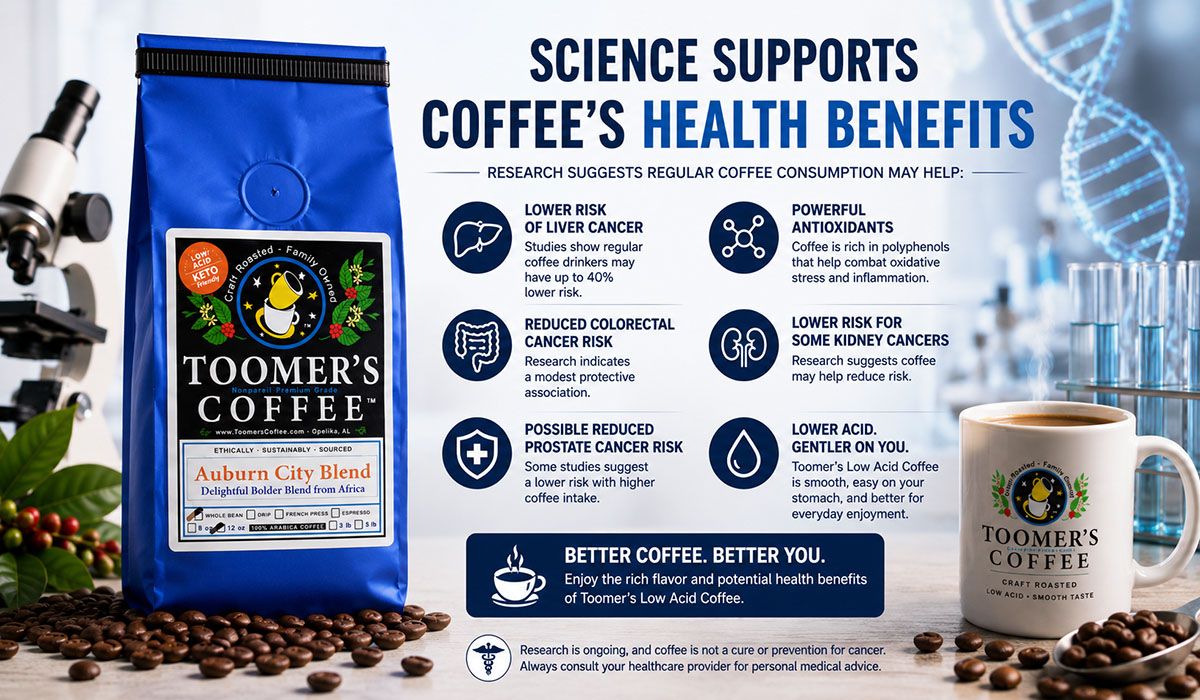
Coffee is one of the most-studied beverages in nutrition science.
And while no single food or drink prevents cancer outright, a growing body of high‑quality research shows consistent, modestly protective associations between coffee consumption and several cancer outcomes. Below are nine evidence‑based ways coffee appears to help.
1) Strongest evidence — lower risk of liver cancer
Multiple large meta‑analyses and pooled studies report that higher coffee intake is associated with substantially lower risk of hepatocellular carcinoma (HCC). Dose‑response analyses suggest each additional cup per day is linked with a roughly 10–15% lower HCC risk, and habitual drinkers (2–5 cups/day) show even larger relative reductions. Proposed mechanisms include improved liver enzymes, reduced inflammation, and beneficial coffee phytochemicals.
2) Reduced risk of chronic liver disease (a major cancer pathway)
Beyond primary liver cancer, regular coffee drinking has been associated with lower rates of chronic liver disease and cirrhosis — conditions that strongly predispose to HCC. This suggests coffee may act upstream by protecting liver health over decades.
3) Lower colorectal cancer (CRC) risk in some studies
 Several cohort studies and meta‑analyses find modest inverse associations between coffee and colorectal cancer, especially for colon (vs. rectal) cancer and in certain populations. Some studies report protective effects for both caffeinated and decaffeinated coffee, hinting at non‑caffeine compounds (polyphenols, diterpenes) as contributors.
4) Possible reduced prostate cancer risk and improved outcomes
Systematic reviews indicate higher coffee intake is generally associated with lower incidence of aggressive prostate cancer and with better outcomes in some analyses. Evidence varies by study design, but overall trends across multiple cohorts are supportive.
5) Small inverse associations for some female cancers (eg, endometrial, breast)
Meta‑analyses and pooled analyses suggest coffee may slightly lower endometrial cancer risk (likely via effects on insulin and estrogen metabolism) and may be neutral-to-protective for breast cancer, particularly in postmenopausal women — though effects are smaller and not uniformly reported.
6) Lower risk for some genitourinary cancers (kidney, bladder) in pooled data
A number of cohort meta‑analyses show a modest inverse association between coffee and renal (kidney) cancer; data on bladder cancer are mixed but do not support harm. These findings again point to antioxidant and anti‑inflammatory constituents in coffee.
7) Potential mechanisms: antioxidants, anti‑inflammatory, metabolic improvements
Coffee contains chlorogenic acids, cafestol, kahweol, and other polyphenols with antioxidant and anti‑inflammatory activity. Coffee is also associated with lower risk of type 2 diabetes and improved insulin sensitivity — metabolic changes that may reduce cancer risk for insulin‑sensitive tumors (eg, endometrial, colorectal).
8) Important caveat — smoking confounds some associations (especially lung cancer)
Some studies have reported a positive association between coffee and lung cancer, but these are almost certainly confounded by smoking (people who smoke often drink more coffee). Well‑adjusted analyses generally remove the apparent lung‑cancer signal. In short: coffee itself is unlikely to increase lung cancer risk; smoking remains the dominant driver.
9) Safety note — temperature matters more than coffee itself
In 2016 the IARC (World Health Organization’s cancer agency) concluded coffee per se is not classifiable as carcinogenic, but very hot beverages (>65°C / ~149°F) are “probably carcinogenic” for esophageal cancer. Drink your coffee at a sensible temperature. Otherwise, current evidence leans toward neutrality or modest protection for many cancer types.
10) Choose A High-Quality, Lower-Acid Coffee You Enjoy Every Day

If the research on coffee’s potential health benefits encourages you to make coffee part of your daily routine, the next step is simple: choose a high-quality coffee you’ll look forward to drinking every day. Consistency matters far more than chasing the latest health trend.
At Toomer’s Coffee Roasters, we’ve been producing premium specialty coffee since 2004 using our unique infrared roasting process, which creates a remarkably smooth cup that many customers find naturally lower in acidity than conventionally roasted coffees. While no coffee can prevent cancer or replace a healthy lifestyle, enjoying a flavorful, lower-acid coffee may make it easier to include moderate coffee consumption as part of an overall wellness-focused lifestyle.
If you’re looking for exceptional taste, premium specialty-grade beans, and a smooth, lower-acid cup, we invite you to discover the difference that Toomer’s Coffee can make.
Bottom line (what readers and clinicians should know)
-
The strongest, most consistent protective association is for liver cancer and chronic liver disease.
-
For colorectal, prostate, renal, and some female cancers the evidence suggests modest protection, but results vary.
-
Most studies are observational (association, not definitive causation), though dose‑response patterns and plausible biological mechanisms strengthen the case.
-
Confounding factors (especially smoking) must be considered. Drinking very hot coffee may increase esophageal cancer risk; otherwise moderate coffee intake (1–4 cups/day) appears safe and often beneficial.
-
Coffee should be seen as one component of a healthy lifestyle (don’t substitute it for smoking cessation, healthy weight, vaccination, screening, and other proven prevention strategies).
References (selected, evidence‑based sources)
-
Poole R, Kennedy OJ, Roderick P, Fallowfield JA, Hayes PC, Parkes J. Coffee consumption and health: umbrella review of meta‑analyses of multiple health outcomes. BMJ. 2017;359:j5024. https://www.bmj.com/content/359/bmj.j5024
-
Bravi F, Bosetti C, Tavani A, et al. Coffee and hepatocellular carcinoma risk: a meta‑analysis. Hepatology. 2007; (and updated meta‑analyses). Example review: Kurozawa Y et al. 2016. https://pubmed.ncbi.nlm.nih.gov/23660416/
-
European Journal of Cancer Prevention. Coffee and risk of hepatocellular carcinoma and chronic liver disease: systematic review and meta‑analysis of prospective studies. 2017. https://journals.lww.com/eurjcancerprev/fulltext/2017/09000/coffee_and_the_risk_of_hepatocellular_carcinoma.2.aspx
-
Cui Y, Zheng Y, et al. Coffee consumption and risk of colorectal cancer: a systematic review and meta‑analysis. Nutrients / PubMed. 2019. https://pubmed.ncbi.nlm.nih.gov/30909640/
-
Li Y, Zhang J, et al. Coffee consumption and colorectal cancer risk: meta‑analysis. Oncotarget. 2016. https://www.ncbi.nlm.nih.gov/pmc/articles/PMC4864536/
-
Zhang X, Ugai T, et al. Coffee consumption and prostate cancer risk: systematic review and meta‑analysis. BMJ Open. 2021;11:e038902. https://bmjopen.bmj.com/content/11/2/e038902
-
Health benefits review: Coffee Consumption and Cancer Risk: An Assessment of the Health Effects (review article). NCBI PMC. 2021. https://www.ncbi.nlm.nih.gov/pmc/articles/PMC8562048/
-
Grosso G, Micek A, et al. Coffee consumption and breast cancer risk: dose‑response meta‑analysis. 2021. https://pubmed.ncbi.nlm.nih.gov/33832295/
-
WCRF / AICR: Diet, Nutrition, Physical Activity and Liver Cancer (summary of evidence and dose‑response estimates). 2015/updates. https://www.wcrf.org/dietandcancer/liver-cancer/ (and related report PDF).
-
Wang M, Hu K, et al. Coffee consumption and renal cancer: meta‑analysis. PMC 2021. https://www.ncbi.nlm.nih.gov/pmc/articles/PMC8738141/
-
Coffee & Health (Scientific organization summary): Bladder, kidney and prostate cancers — overview and citations. https://www.coffeeandhealth.org/health/health-conditions/cancer/bladder-kidney-and-prostate-cancers
-
Reviews on mechanisms (antioxidants, cafestol, kahweol, chlorogenic acids): Coffee Consumption and Cancer — PMC review. https://www.ncbi.nlm.nih.gov/pmc/articles/PMC9916720/
-
Li X, et al. Coffee consumption and lung cancer: recent meta‑analyses highlight confounding by smoking. Scientific reports (2024) and commentary. https://www.nature.com/articles/s41598-024-62619-6
-
JAMA / JAMA Oncology: Coffee Intake and Survival in Advanced or Metastatic Colorectal Cancer — examples of mixed findings and need for careful interpretation. https://jamanetwork.com/journals/jamaoncology/fullarticle/2770262
-
IARC (WHO) Monographs Volume 116: Drinking coffee, mate, and very hot beverages — summary: coffee not classifiable as carcinogenic; very hot beverages probably carcinogenic. 2016. https://www.iarc.who.int/featured-news/media-centre-iarc-news-mono116/ and full monograph PDF: https://publications.iarc.who.int/_publications/media/download/5598/f49696e5e7a10f69ff3fc1cc673b3f77b4e8af43.pdf